
Authored by Jocelyn Hatcher, UNG Press Intern
Editing and keeping track of details for a work of writing can seem daunting. How do editors keep track of everything? Style sheets and style guides. They are handy writing tools that can be cross-used in both scholarly work and trade publishing, making them very versatile. Some style guides are even designed for specific fields or concentrations. Style sheets and style guides keep papers and manuscripts organized throughout stages of editing to ensure consistency throughout the document. Read more and learn what makes them different, as well as the benefits they provide to authors.
Purpose of a style guide
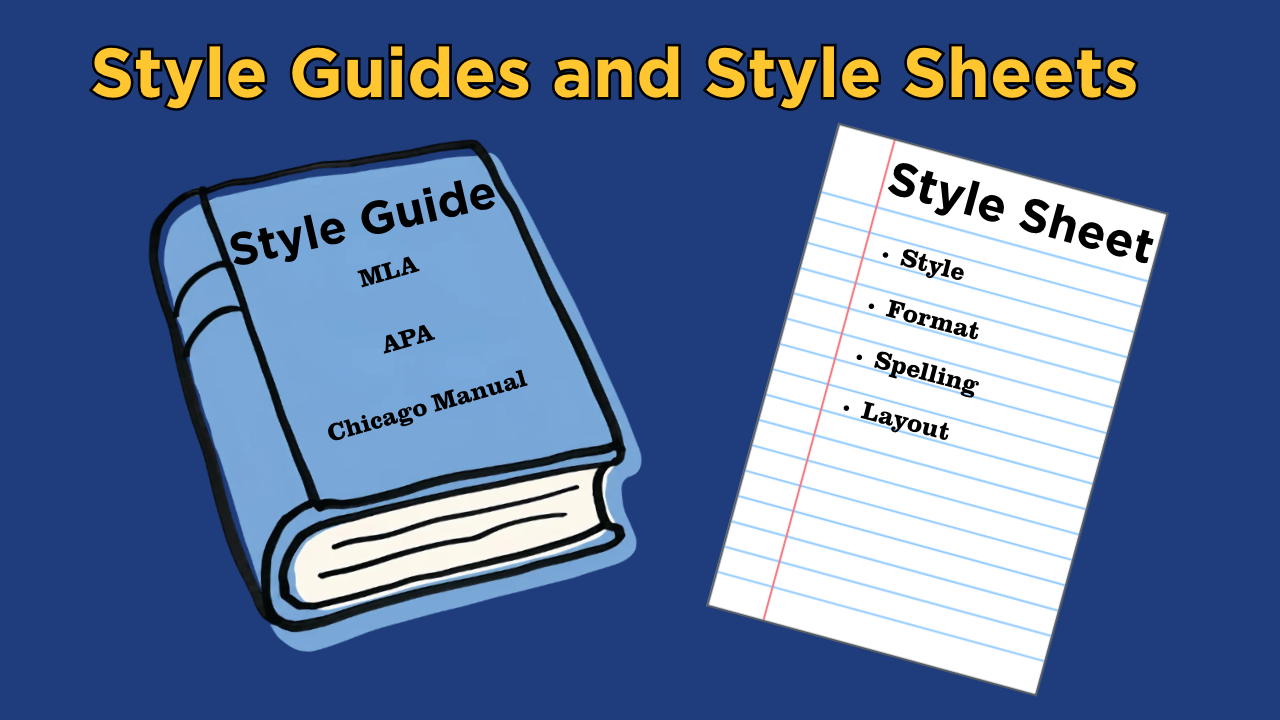
Style guides clarify standard formatting and organizational expectations for works written in a particular style. They’re a set of guidelines for grammar and language as well as formatting headings and font (sizes), that help ensure consistency. Purdue OWL summarizes the purpose of a style guide as a “way of making common elements consistent across documents written by many writers, in many places, and in many circumstances.” A style guide helps writers in the same field easily navigate others’ work, understand things such as quote introductions or where to find citation information, and how to make their own work match the style of their field (Purdue Writing Lab).
Different types of style guides
Some of the most popular style guides are MLA, APA, CMOS, and AP. These styles can be used by students across various academic levels and in professional settings. MLA stands for Modern Language Association and is used in the humanities (Fields et al.). The MLA style guide primarily centers on research papers or scholarly work (Purdue Writing Lab). APA is the Manual of the American Psychological Association and is used in the social sciences or education (Fields et al.). APA includes guidelines for writing topics such as rules for nondiscriminatory language and research with indigenous populations (Purdue Writing Lab).
CMOS and AP can be used in a professional setting, such as publishing. CMOS is the Chicago Manual of Style. It can be used in the humanities, but also in professional publishing. CMOS tackles matters like copyright, style and usage, and sources (Chicago Manual of Style). On the CMOS website, style and usage show how to use things such as punctuation, style, and format dialogue or quotes in a work. AP stands for the Associated Press and serves as a style guide for journalism and publishing, like newspapers and magazines (Purdue Writing Lab). The AP style focuses its guiding principles on consistency, clarity, accuracy, and brevity, with an emphasis on avoiding stereotypes or offensive language in writing (Purdue Writing Lab).
What is a style sheet?
A style sheet is used to record the style and formatting across a document to ensure consistency. In scholarly work, a style sheet will track spelling, differences in punctuation, layout, and sources (Dietz). They also track contributor names, field-specific terminology, and abbreviations. In a trade manuscript, it will track spelling, names and places, style, character details, preferred spelling that differs from a style guide, characteristics, etc. A trade manuscript’s style sheet acts like a dictionary of personal preferences across an author’s work while also maintaining consistency. For instance, if there are two different spellings of the same name, like Sofia and Sophia. They can be helpful with keeping track of story details like character deaths and character/essential history (Dietz).
Conclusion
A style guide helps authors pick a writing style and adhere to its grammar and formatting rules so that it is more uniform across the work. In scholarly work, it helps with formatting headings and fonts, plus keeping track of citations, abbreviations, and field-specific terminology. Overall, both help authors and editors of all types of writing know what writing style and formatting guidelines to adhere to, while also allowing them to ensure consistency across their work. That consistency will help readers understand the writing without being distracted by errors or confusion.
Sources:
Chicago Manual of Style. “The Chicago Manual of Style, 18Th Edition.” The Chicago Manual of Style Online, 2024, www.chicagomanualofstyle.org/book/ed18/frontmatter/toc.html. Accessed 23 Oct. 2026.
Dietz, Lynda. “Why Do I Need a Style Sheet?” Medium, The Writing Cooperative, 24 Feb. 2020, writingcooperative.com/why-do-i-need-a-style-sheet-edcee1eae5a2. Accessed 23 Oct. 2026.
Fields, Erin, et al. “Style Sheets.” British Columbia/Yukon Pressbooks, May 2022, pressbooks.bccampus.ca/openubcpub/chapter/style-sheets-open-ubc/. Accessed 23 Oct. 2026.
Purdue Writing Lab. “Style Guide Overview // Purdue Writing Lab.” Purdue Writing Lab, 2018, owl.purdue.edu/owl/avoiding_plagiarism/guide_overview%20.html. Accessed 23 Oct. 2026.
Purdue Writing Lab. “AP Style // Purdue Writing Lab.” Purdue Writing Lab, owl.purdue.edu/owl/subject_specific_writing/journalism_and_journalistic_writing/ap_style.html. Accessed 1 Nov. 2026.
Leave a Reply