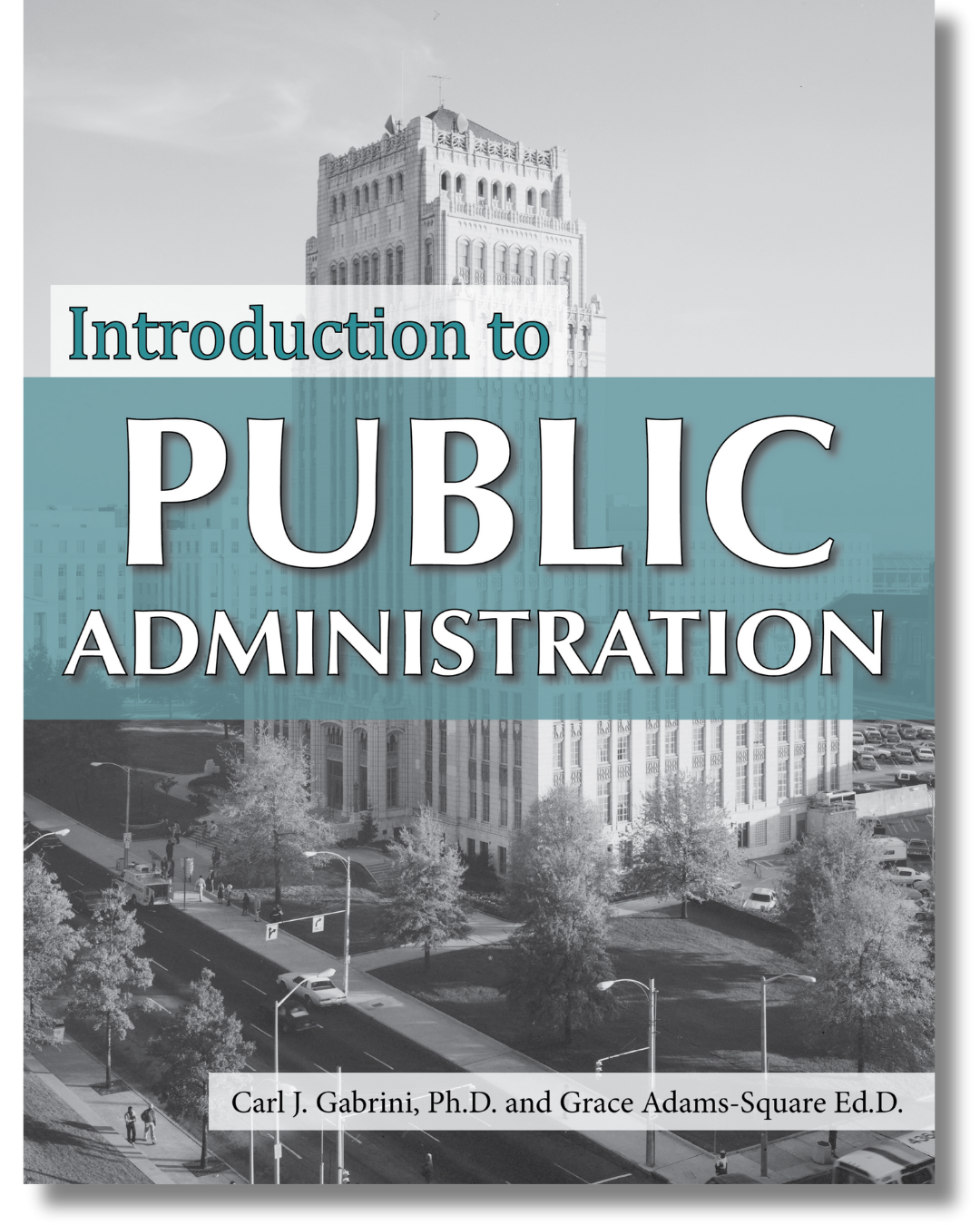
Introduction to Public Administration
Carl J. Gabrini
Grace Adams-Square
ISBN: 978-1-959203-16-2
Print Version: $29.99
Digital Version: Free
Introduction to Public Administration provides a clear, accessible introduction to the principles, structures, and challenges of public administration in the United States.
Introduction to Public Administration provides a foundational overview of the field of public administration within the United States, focusing on the structure, functions, and challenges of government and public service. Designed as an introductory text, the book emphasizes core concepts that help students understand how government operates and how public administrators contribute to the execution of public policy.
The text explores public administration as both a practical and academic discipline, examining its political, legal, managerial, and professional dimensions. It introduces key topics such as the constitutional and legislative foundations of U.S. public administration, the development of administrative agencies, and the role of public administrators in implementing laws and serving the public interest.
Readers are guided through essential areas including public sector decision-making, public policy development, human capital management, ethics, efficiency and effectiveness, and public financial management. The book also traces the evolution of public administration theory, highlighting major paradigms and their influence on modern governance.
With a focus on real-world application, the text addresses contemporary challenges facing public administrators, such as accountability, transparency, technological change, and the complexity of decision-making in a highly visible and regulated environment. It underscores the importance of competence, ethical leadership, and service in meeting the needs of citizens across federal, state, and local governments.
Introduction to Public Administration serves as a comprehensive starting point for students interested in public service careers, offering the foundational knowledge needed to understand and navigate the modern public sector.
Please note that the file is large and may take several minutes to download.
- CHAPTER 1: INTRODUCTION TO PUBLIC ADMINISTRATION
- Introduction
- What is Public Administration
- How is Public Administration Different From Business Administration?
- Why is it Important to Study Public Administration
- How is the Rest of the Book Organized?
- CHAPTER 2: THE CONSTITUTIONAL AND LEGISLATIVE FOUNDATIONS OF U.S. PUBLIC ADMINISTRATION
- Introduction
- Constitutional Foundations of U.S. Public Administration
- Statutory Origins of Federal Executive-Level Agencies
- The Origin, History, and Mission of Federal Agencies: A Comparison
- The Role of Congressional Oversight of Federal Executive Agencies
- Careers in Public Service
- Conclusion
- CHAPTER 3: PARADIGMS OF PUBLIC ADMINISTRATION
- Introduction
- Pre-1800’s: The Early Years
- 1887 to 1926: Bright Line Between Politics and Administration
- 1927 to 1937: Developing Administrative Principles
- 1938 to 1947: Challenging the Existing Paradigms
- 1948 to 1970: Struggle for an Identity
- 1971 to Present: Breakthroughs-New Public Administration (NPA)
- 1971 to Present: Breakthroughs-New Public Management (NPM)
- 21st Century and Beyond: New Directions?
- Conclusion
- CHAPTER 4: PUBLIC SECTOR DECISION-MAKING
- Introduction
- How Are Decisions Made?
- What External and Internal Forces Act on Decision-Making?
- Administrative Controls: Types and Strategies
- Performance Measurement and Determining Impacts
- Conclusion
- CHAPTER 5: PUBLIC POLICY
- Introduction
- Public Policy Theories
- Who Makes Policy?
- Executive Policy Priorities
- How Is Policy Developed?
- What Are the Challenges in Implementing Policy?
- Conclusion
- CHAPTER 6: HUMAN CAPITAL IN PUBLIC ADMINISTRATION
- Introduction
- Origins of the Term Human Capital
- History of Public Sector Human Resources in the U.S.
- Challenges Facing Public Sector Human Resources
- Current State of Public Sector Employment in the U.S.
- Impact of Innovation and Technology on Public Sector Human Resources
- Conclusion
- CHAPTER 7: ETHICS IN THE PUBLIC SECTOR
- Introduction
- Definitions of Ethics and Its Importance in Public Administration
- How Ethical Conduct of Members in Government Is Managed in the U.S.
- Describe a Relevant Ethical Decision-Making Model and Its Use
- Explain the Ethical Challenges Present in the 21st Century
- CHAPTER 8: EFFICIENCY AND EFFECTIVENESS IN PUBLIC ADMINISTRATION
- Introduction
- Defining Efficiency and Effectiveness
- Origin of Efficiency and Effectiveness
- Integrating Efficiency and Effectiveness of Public Administration
- Integrating Efficiency with Leadership
- Conclusion
- CHAPTER 9: PUBLIC FINANCIAL MANAGEMENT
- Introduction
- Define Public Financial Management Its Importance
- Overview of Public Financial Management
- Overview of Federal Financial Management
- State Budget Process
- Local Government Budget Process
- Financial Accounting, Reporting, Analysis, and Controls
- CHAPTER 10: REFLECTIONS ON PUBLIC ADMINISTRATION: KEY TAKEAWAYS AND CHALLENGES
- Introduction
- Summary of Main Topics
- Managing and Leading Public Organizations
- Challenges: Conflict in Society and Politics
- Challenges: Global Nature of Business and Politics
- Challenges: Technology and Innovation
- Concluding Thoughts
Related Titles