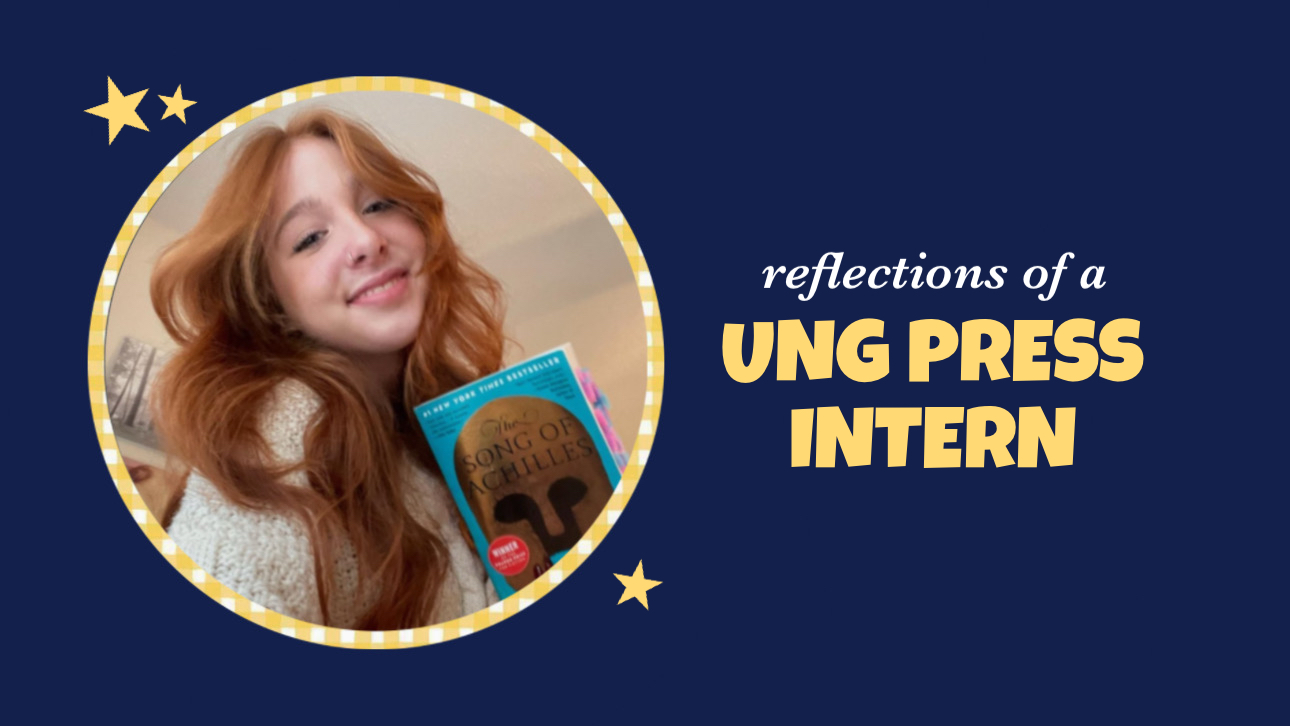
Authored by Cheyenne Clenney, UNG Press Intern
I wasn’t always an English major at the University of North Georgia. In fact, I sort of fell into it, despite enjoying English classes my whole life. It wasn’t until I took a grammar course my second year of college that I realized that I wanted to pursue a career in publishing. My goal to become a book editor was born from a really great grammar professor and my newfound fascination of syntax, semantics, and accurate punctuation. Applying for an internship at UNG Press was a no-brainer; I knew it would be a chance to gain invaluable insight on the publishing industry before I graduated, and I was right.
When I started this internship, I thought I had a pretty good grasp on what professional publishing entailed. How much could there possibly be to know about what it takes to edit a book and get it to the shelves? Turns out, quite a lot. In team meetings, I heard terms that were unfamiliar to me—like ‘metadata’ and ‘BISAC’—and encountered them more and more throughout industry research and communication. In various assignments, I had the chance to explore aspects of publishing that were much more complex than I previously thought. I knew I wanted to learn as much as I could about a book editor’s responsibilities, seeing as I will one day be an editor myself; I didn’t know the editing process was divided into four distinct stages. After diving into the topic to write a blog post, I learned that I don’t want to be just any editor, I want to be a copyeditor.
Any publishing internship is advantageous, but the UNG Press internship is unique. Because it is a teaching press, there is a special emphasis placed on the intern and what they wish to gain from experience. I was given the chance to focus on my interests (copyediting and the entire book editing process) while also working on cool projects to build skills in other areas—like writing a killer reader’s report or creating an expansive style sheet from scratch. So, not only am I expanding my publishing knowledge, but I am also building a portfolio of my own work that will be useful to me when I apply for jobs after graduation. Ultimately, this internship put me miles ahead of where I was when I first started, both intellectually and career-wise.
Leave a Reply